
What is the Coptic Orthodox Church?
One of the oldest Christian churches in the world
Our Origins
The Coptic Church was established in the name of the Lord Jesus Christ by St. Mark the Evangelist in the city of Alexandria around 43 A.D. The church adheres to the Nicene Creed. St. Athanasius (296-373 A.D.), the twentieth Pope of the Coptic Church effectively defended the Doctrine of the Lord Jesus Christ's Divinity at the Council of Nicea in 325 A.D. His affirmation of the doctrine earned him the title; “Father of Orthodoxy” and St. Athanasius “the Apostolic”.
The term “Coptic” is derived from the Greek “Aigyptos” meaning “Egyptian”. When the Arabs arrived in Egypt in the seventh century, they called the Egyptians “qibt”. Thus the Arabic word “qibt” came to mean both “Egyptians” and “Christians”.
The term “Orthodoxy” here refers to the preservation of the “Original Faith” by the Copts who, throughout the ages, defended the Old Creed against the numerous attacks aimed at it.
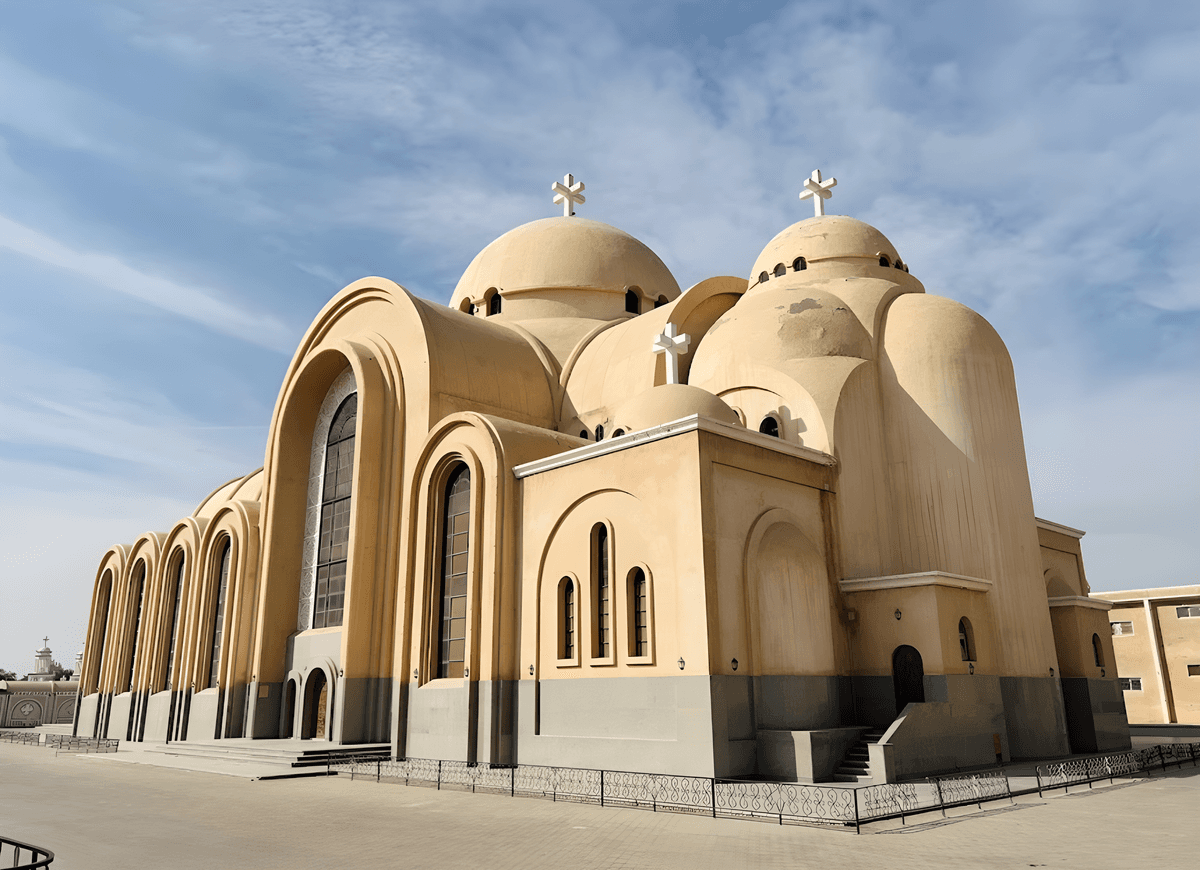
St. Bishoy Monastery, Wadi El-Natroun, Egypt

Our Faith
The Coptic Orthodox Church worships the Father, the Son and the Holy Spirit in the Oneness of Nature. We believe in One God; Father, Son and Holy Spirit three equal Co-Essential and Co-Indwelling Hypostasis (Persons). The Blessed and Holy Trinity is our One God. We believe that Lord Jesus Christ, the Only-Begotten of the Father and Who is One with Him in Essence is the only Savior of the world.
We are Miaphysites; There is a difference between the “Monophysites” who believe in just One Single Nature (Divine) of Lord Jesus Christ and the “Miaphysites” who believe in One United Nature or One Composite Nature (Divine & Human) of Lord Jesus Christ. We do not believe in just a Single Nature but we do believe in the One Incarnate Nature of the Logos.
Less changes have taken place in the Coptic Church than in any other church whether in the ritual or doctrine aspects and that the succession of the Coptic Patriarchs, Bishops, priests and Deacons has been continuous.
The Ancient Faith
What We Believe
The Holy Trinity
One God in three persons: Father, Son, and Holy Spirit.
The Incarnation
Jesus Christ is fully God and fully man, united in one nature.
Sacred Scripture & Tradition
The Bible and the teachings of the Church Fathers guide our faith.
The Seven Sacraments
Baptism, Chrismation, Eucharist, Confession, Unction, Matrimony, and Priesthood.
The Communion of Saints
We honor those who lived faithfully and ask for their prayers.
Apostolic Succession
An unbroken line of bishops going back to the Apostles.
The Divine Liturgy
How We Worship
Our worship is liturgical, following ancient prayers, hymns, and rituals passed down through generations. Every gesture, word, and chant carries the weight of two thousand years.
The Divine Liturgy Includes
Scripture Readings
Old Testament, Epistles, and Gospels
Ancient Hymns
Unchanged since the early Church
Holy Incense
Prayers rising to God
The Eucharist
The center of our worship
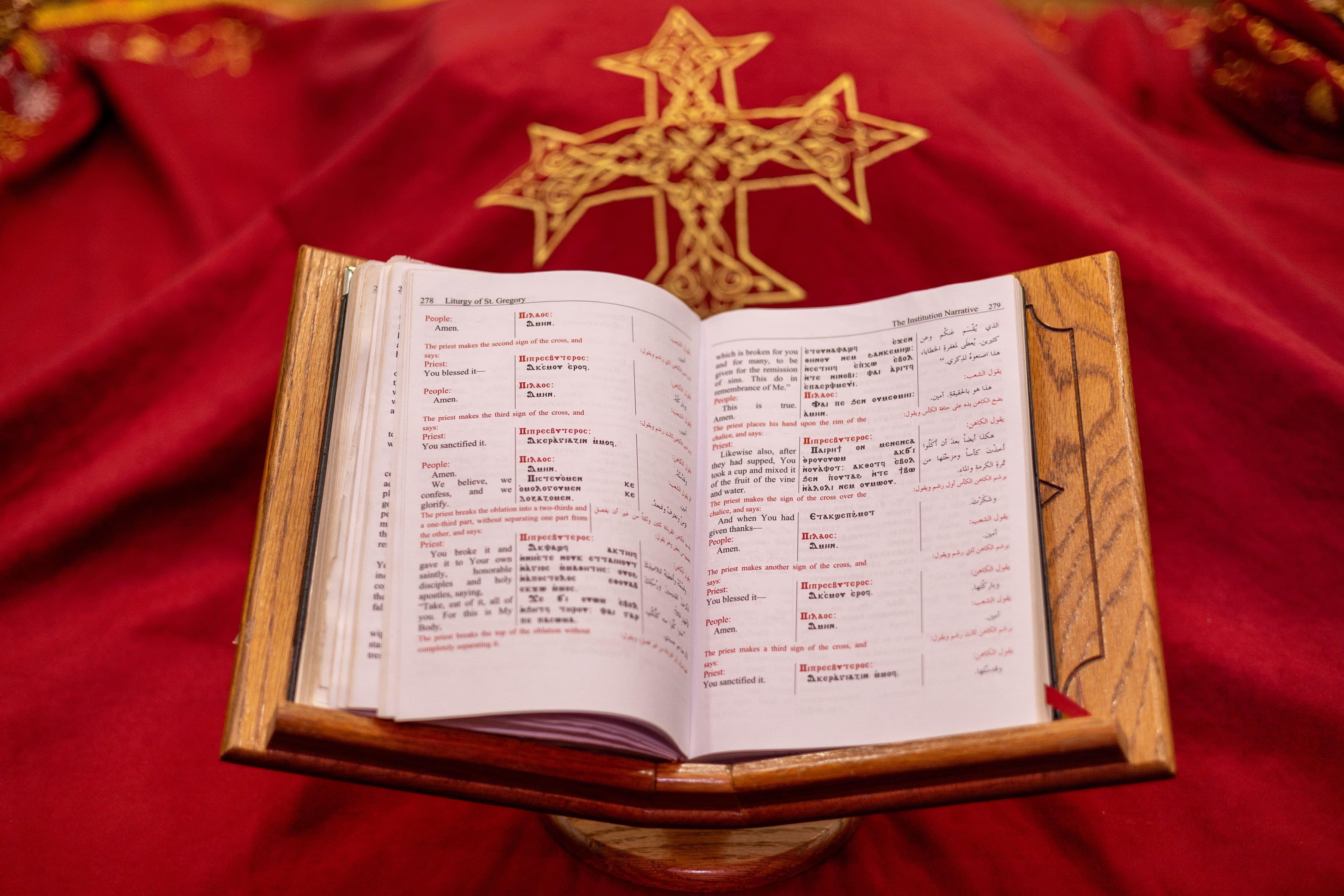
Services are conducted in English, Arabic, and Coptic, the language of ancient Egypt, descended from the pharaohs, connecting us to the earliest Christians.
Distinctions
How Are We Different?
Roman Catholicism
The Coptic Church has been independent since the Council of Chalcedon in 451 AD. We are not under the Pope of Rome, though we share many beliefs. Our Pope (the Pope of Alexandria) leads our church and holds the title “Pope”. In the Coptic understanding, the Pope of Alexandria is the head of the church as “head among equals,” and doctrine is safeguarded by the Holy Synod rather than through a claim of universal papal supremacy or papal infallibility.
Protestant Churches
The Coptic Orthodox Church understands the Christian faith as Holy Scripture lived within Holy Tradition, specifically the apostolic teaching, worship, and life of the Church that preserves and interprets the Bible, rather than treating “Bible alone” as the sole authority. We also keep an unbroken sacramental (mysteries) life in the Church, including the Holy Eucharist, repentance and confession, and the priesthood, as part of the seven sacraments Christ established for His Church. And we venerate the Virgin Mary and the saints (honor and asking for their prayers), while worship belongs to God alone.
Eastern Orthodox (Greek, Russian, etc.)
While we share much with the Eastern Orthodox (apostolic succession, sacramental life, and the faith of the early Church), we have been separate since the Council of Chalcedon (451 AD). The core disagreement was Christology, specifically how to express the unity of Christ's divinity and humanity. The Oriental Orthodox did not accept Chalcedon's “in two natures” wording, and instead confess the formula of St Cyril of Alexandria: “One Incarnate Nature of God the Logos” (Miaphysis), while rejecting both Nestorian division and Eutychian “monophysitism.”