Our Patron Saint
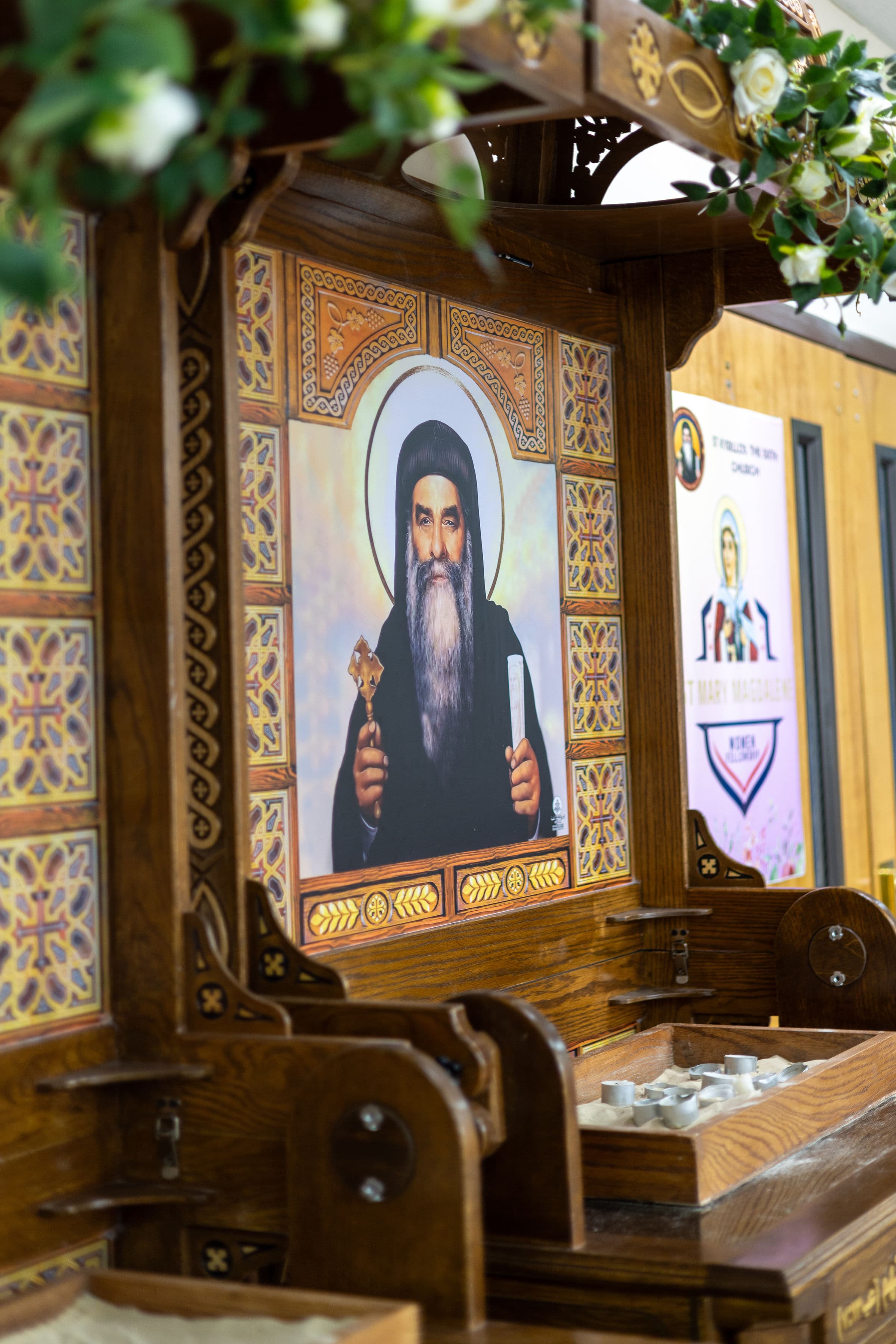
Pope Kyrillos VI
1902 – 1971 • 116th Pope of Alexandria
Orthodox churches are named after saints, people who lived righteous, God-fearing lives and were recognized by the Church for their holiness. Their stories become encouragement for every generation that follows them.
Our patron saint is Saint Pope Kyrillos VI, the 116th Pope of Alexandria, remembered on March 9th as a man of extraordinary prayer, deep humility, and countless miracles. He brought the Coptic Church into a new era of spirituality and was beloved by Christians and non-Christians alike across Egypt.
Early Life
A Heart Set Apart
Pope Kyrillos VI was born on August 2, 1902 and was given the name Azer Ata. His father was a church deacon, and Azer grew up in a middle-class family in Egypt. After completing high school he worked for a shipping company in Alexandria, but his heart was elsewhere. He was content with little food and the ground to sleep on.
Much against his family's wishes, he resigned and entered the Monastery of El-Baramous on July 27, 1927. He was ordained a monk on February 25, 1928 and given the name Mina, after his patron saint, St. Mina of Mariout. He was ordained priest on July 18, 1931.
Father Mina's love for God was so consuming that he desired a life of complete solitude. He was only thirty years old when he asked. The elder monks refused him: “You are only thirty years old and your monastic life is only five years. Do you want to pursue the life of solitude in the desert whereas many others before you have struggled for the same goal for thirty or forty years and failed?” Father Mina was undeterred.
The Desert & The Windmill
A Life of Solitude
Father Mina lived first in a cave near the monastery, then headed to the Monastery of Saint Anba Samuel the Confessor at Zawarah in Upper Egypt, where he devoted great effort to restoring that historic landmark. When the monastery was restored, he moved on to a deserted windmill on El-Moukatam mountainat the outskirts of Cairo.
This windmill was totally abandoned and dangerous, miles from the nearest city, surrounded by scorpions and snakes. Here, Father Mina spent his time in prayer and contemplation because of his love for his Saviour. Satan laid many obstacles before him. A guard was instigated not to carry water to the monk. God then sent one of His saints in a dream to rebuke the guard, who rushed to bring water to Father Mina who was in urgent need.
In another incident, robbers came to the windmill and beat Father Mina, injuring his head. When he regained consciousness and found himself bleeding, he crawled to the icon of Saint Mina and placed it on his wound. The bleeding stopped immediately. He then walked fifteen miles to reach a hospital. The doctors were speechless.
“Let us disappear for God to appear with His blessed glory.”
Pope Kyrillos VI, from his first papal letter
Father Mina eventually built a church in Ancient Cairo under the name of Saint Mina and lived there until his ordination as Pope. He found himself surrounded by college students, many from outside Cairo, so he started a dormitory, the first church-affiliated student dormitory in modern Egypt. Many of those students went on to become bishops and priests, including Pope Shenouda III, his successor.
Father Mina used to clean the dormitory and lavatories himself, without letting anyone know, and would not allow anyone else to do it. By humiliating himself and serving others, he fulfilled the Lord's commandment: “Whosoever will be chief among you, let him be your servant.” (Matthew 20:27)
1959 – 1971
The 116th Pope of Alexandria
Father Mina was ordained Pope on Sunday, May 10, 1959 and took the name Kyrillos VI. Before him, five Popes had borne that name. The first was Saint Cyril the Great, the pillar of faith who defended the unity of Christ's person against Nestorianism at the Council of Ephesus (431 AD).
On his enthronement day, at the end of the liturgy, the new Pope stood for hours blessing each person individually. Bishops begged him to rest when they saw his exhaustion and sweat. He refused to send anyone away. From then on, he continued this practice throughout his papacy.
He abolished any barrier between himself and his people. The room in his private quarters was famously humble. When a foreign priest offered to furnish it with luxury, the Pope laughed: “The room in its current state is still much better than the manger where Christ was born.”
The Life of Prayer
12,000 Masses
It is said that Pope Kyrillos prayed more than 12,000 Divine Liturgies during his lifetime. He would begin at 3:00 or 4:00 in the morning with the Holy Psalmody and finish liturgy early so that his children could get to school and work. This continued for thirty-five years since his days as a hermit.
Those who spent time with him described it: six continuous hours of prayer. Midnight Agpeya, baking the korban, raising incense, then the Divine Liturgy. Afterwards he would meet with all who came: the sick, the uncertain, the tormented. “Whoever sat with Father Mina obtained a heavenly relief. One would leave knowing that his ship had found a true haven.”
In his last days, gravely ill, he had a speaker connected from the Cathedral to his bedroom so he would not miss the liturgy he could no longer stand to serve.
Legacy
What He Built
The Return of St. Mark's Relics
For centuries the Coptic Church longed for the return of the body of St. Mark, martyred in Alexandria in 68 AD, from Italy. Under Pope Kyrillos VI, this dream was realized. As the plane landed, luminous beings in the shape of white pigeons flew over Cairo Airport and were seen by all present, half an hour before midnight, when real pigeons do not fly.
Apparitions at Zeitoun
During his papacy, the Blessed Virgin Mary appeared at the Church of Zeitoun in Cairo — witnessed by millions including non-Christians — in a series of miraculous apparitions documented worldwide.
Coptic Churches Worldwide
For the first time in Coptic history, Pope Kyrillos established churches in Asia, America, Canada, and Australia, and sent priests to Europe and Africa, planting the ancient faith across the modern world.
The Monastery of Saint Mina
He founded and expanded the Monastery of Saint Mina at Mariout, honoring his patron saint and creating a place of pilgrimage and prayer that continues to this day. His holy body rests there per his final wishes.
Miracles
A Witness to God's Power
It is said that nearly every person who lived during the days of Pope Kyrillos witnessed a personal miracle: healings from illness, the casting out of demons, miraculous resolution of difficult circumstances, and the revelation of hidden things that led people to faith and repentance. Saint Pope Kyrillos' miracles continue to be documented to this day.
More than 18 printed volumes document the miracles of Pope Kyrillos VI, originally published in Arabic by the Pope Kyrillos VI Society and translated into English, French, and other languages.
Feast Day
The feast of Pope Kyrillos VI is celebrated on Amshir 30 (Coptic calendar) / March 9th (Gregorian), the day of his departure.
See Our Schedule